Will Heckler and Koch Make 94s Again?
| Heckler & Koch G11 | |
|---|---|
 A G11 K2 (final version) with bayonet | |
| Type | Set on rifle Calorie-free automobile gun |
| Place of origin | Westward Germany |
| Production history | |
| Designer | Heckler & Koch |
| Designed | 1968–1990 |
| Variants |
|
| Specifications | |
| Mass |
|
| Length | 750 mm (30 in) |
| Barrel length | 540 mm (21 in) (Non including bedroom, 155 mm per twist) |
| | |
| Cartridge |
|
| Action | Gas-operated, rotary breech (for G11 series) |
| Rate of burn |
|
| Muzzle velocity | C. 930 m/s (three,100 ft/s) |
| Constructive firing range | 400 chiliad |
| Feed organization | 45- or fifty-round detachable box magazine |
| Sights | Integrated optical sight |
The Heckler & Koch G11 is a non-production paradigm assail rifle adult from the belatedly 1960s–1980s by Gesellschaft für Hülsenlose Gewehrsysteme (GSHG) (German for "Clan for Caseless Rifle Systems"), a conglomeration of companies headed by firearm manufacturer Heckler & Koch (mechanical technology and weapon design), Dynamit Nobel (propellant composition and projectile design), and Hensoldt Wetzlar (target identification and optic systems). The rifle is noted for its use of caseless ammunition.
It was primarily a project of W Germany, though it was of significance to the other NATO countries also. In particular, versions of the G11 were included in the U.S. Advanced Gainsay Rifle program.
In 1990, H&One thousand finished the development of the G11, intended for the Bundeswehr and other NATO partners. Although the weapon was a technical success, it never entered full production due to the political changes of German reunification and lack of procurement contract.[three] Only m units were ever produced, some of which made their way into the hands of the Bundeswehr. Ultimately, the German armed services replaced the G3 with the G36.[iv]
History and development [edit]

Heckler & Koch ACR epitome
Development began effectually 1967 when NATO launched the idea of adopting a second standard small-caliber ammunition. Three competitors were then nominated: one American, another Belgian, and finally the German Heckler & Koch. NATO quickly lost interest in caseless ammunition just the West German Regime held on.[5] During 1968–1969, the authorities of what was then West Germany started a feasibility study into a future attack rifle and 3 contracts were awarded respectively to Diehl, IWKA Mauser and Heckler & Koch (based in Oberndorf). The terms of reference (specifications) were very general, calling for an improved infantry weapon with a meliorate striking probability than any then in being, all the same fulfilling the FINABEL (named subsequently France, Italy, Netherlands, Allemagne, Belgium and Grand duchy of luxembourg) range and rate of fire characteristics. The designers were given a free mitt for the methods used, merely Heckler & Koch realized that the only manner to obtain whatsoever pregnant improvement was to radically change the arroyo.[5] [6] [7]
From the very beginning, it was obvious the required hit probability could not be achieved with common fe sights, hence, it was given equal importance. Simply an optical sight could practise it. The Hensoldt AG, having delivered 100,000 optical sights for the G3, cooperated with H&K on developing a modest sight with low power magnification which would allow target acquisition with both eyes. However, it was dropped considering of the cost. Considering the weapon was to exist short, only 37 cm would have been left for a sightline, too short for a common atomic number 26 sight, so that was out of the question. In mid 1968, Hensoldt presented an affordable reflector sight. It was based on an old and well-nigh forgotten patent, and a modernized model had to be built by a main from the assembly department. On September xxx, 1968, Hensoldt was commissioned for a study for further development.
Numerous studies followed in the period betwixt 1970 and 1971. Intensive tests were run by Heckler & Koch and Dynamit Nobel in search of a suitable ammunition. The early side manner ignition design gave way to a tail ignition design. By 1970, studies progressed far enough to permit the construction of an automatic single- and 3-shot burst model but without full-automatic operation. Sometime in 1970, the box mag was selected. To study the dispersion, a model firing 9×19mm and equipped with the reflexive sight was used. It had a cadency of 2400 rpm. The study supposedly was conducted by the Fraunhofer Society (Fraunhofer-Gesellschaft) (based in Weil am Rhein). To determine the precision, a laser was used, fired onto a moving picture during the iii-shot flare-up. The gratis-floating barrel pattern was found to contribute significantly to the precision of the weapon. At the end of September/beginning October 1971, the weapon was fully completed with full automated fire and chambered for 4.9 mm and fed from the side.[7]
In January 1973, the defense ministries of W Germany and Great Great britain agreed on exchanging data on development of infantry weaponry and ammunition. The agreement was designed to benefit both partners as. West Germany was to work on caseless ammunition while Great Britain would work on optimizing a firearm for 4.85x45 mm armament.
Meanwhile, the German defence ministry targeted unveiling of the weapon to NATO in 1975 with a field test of the first weapon to brainstorm in 1976. In the summertime of 1973, the ministry took on stock to encounter that none of the competitors could present a war-ready weapon. Diehl's design used separate magazines for projectile and propellant.[8] Mauser offered a three-barrel rifle blueprint.[eight] H&G's design with a rotating breech was considered promising. Together with the Federal Office of Defense Technology and Procurement (FODTP)(Bundesamt für Wehrtechnik und Beschaffung),H&Thousand'due south rotating breech was selected for further report and development.
In early on November 1973, at a NATO workshop conference in Brussels, West Germany was appointed to develop the 2nd generation (rifleman) rifle. H&G'southward new weapon was to be presented in sufficient numbers to NATO in April 1977. NATO-broad testing began in 1977 with the goal of having a second smaller caliber weapon alongside the 7.62×51mm NATO round rifle. Due west Federal republic of germany wanted to accept information technology prepare by then, but the quotient was changed to four.3 mm, delaying prototype evolution past months.[7]
In mid 1974, several fully operational Prototype 1 G11s were presented to the Bundeswehr. On June 14, 1974, the German defense ministry charged the FODTP with initiating the evolution of the weapon. The proof of performance was held on Dec 18 and 19, 1974. The achieved firing rates were given equally 1800 rpm for outburst and 400 rpm for full-automatic. H&K was awarded the development contract (worth 20 million DM[8]) on December 23, 1974. The contract required the completion of development by autumn of 1977, including following field tests. Subsequently, H&K contracted Hensoldt with a continuing development contract.[7] Around 1975, the design was disclosed as a High german minor arm Laid-Open up Patent awarding No. 23 26 525.0 and No. 24 13 615.0.[7] [9]
In early 1976, uncertainty about the viability of the reflex sight rose. The contrast requirements in adverse status and added features similar variable brightness and altitude settings collection cost upwards, exceeding that of a proper telescopic of similar size. On June 11, 1976, it was decided to switch to a telescopic. On June 15, 1976, the specification for a scope was finalized and the first model presented on August 5/six, 1976. In November 1977, the FODTP changed the specification accordingly. At the end of the contract in the summer of 1978, it was establish to satisfy the requirement.
Meanwhile, the caliber was inverse to iv.75 mm with Paradigm iii. Prototype iv and Prototype 5 equipped with the telescopic took role in the preliminary NATO field exam in 1977 in Meppen. After the contract with the FODTP ended H&K, Dynamit Nobel and Hensoldt were forced to continue development on their ain with their individual funds.[7] In 1978, Mauser competed with their own weapon chambered for caliber 4.7 mm in a conventional case design but ultimately lost to the H&K G11.[5] The caseless circular was not yet telescoped and appeared "conventional".[v] [8]
On 28 Oct 1980, NATO approved the standardization (STANAG 4172) of five.56×45mm NATO as second pocket-size caliber cartridge for utilise within the alliance.[10]

Prototypes 13 (summit) and 14 (bottom) in the collection of the Wehrtechnische Studiensammlung Koblenz.
Up to 1982, changes were made following the test. The caliber changed to 4.7x21 mm for Epitome vi. The conventional nitro-cellulose propellant was replaced past High Ignition Temperatures Propellant (HITP) based on Octogen.[11] The butt received polygonal rifling.[five] [7] The rifle case received a design by a dedicated designer.[5] [8] This Prototype 13 became the attention of the numerous media and press.[8] Information technology'south supposed to be the commencement version entering the Avant-garde Combat Rifle (ACR) program.
Meanwhile, evolution shifted still over again to the new caliber four.73x33mm (DM11) in a telescoped form. In 1984, the Gesellschaft für hülsenlose Gewehrsysteme (GHGS), founded by H&G GmbH and Dynamit Nobel AG, completed a license agreement for a custom version (worth United states of america$3.8 million)[12] with the U.S. Department of Defense and for the adoption of caseless ammunition with the Bundeswehr and NATO.[13]
On Dec 8, 1986, Hensoldt was ready to deliver the final "Zieloptik ZO i".
The G11 K1 (K for Konfiguration) production model was completed in March 1987. Field examination and troop trials began in June with the Bundeswehr in Hammelburg and lasted until January 1989. It achieved a 100% higher Ph than the G3. The concluding development of the ammunition was completed toward the finish of 1988 with the same dimensions as 4 years earlier. In March 1989, the first Operator´south Manual was made for the G11 K1 for the ACR evaluation. By and then, work had already started on the G11 K2. On March 3, 1989, the first 5 ACR units were shipped to the Aberdeen Proving Ground. In May, H&Yard began to instruct the testers on how to operate the weapon.[7] [13]
In April 1990, the FODTP certified the G11 for utilise with the Bundeswehr. In May 1990, Tilo Möller, then H&K primary of R&D, presented the G11 to military dignitaries. At the same time, the Chiffonier of Germany (Bundesregierung) confirmed questions by the Bundestag virtually the signing of a contract in early 1990 for the adoption of the G11 and that it is part the upkeep (Haushalt 1990 EPL 14). If information technology is adopted, the front line troops would receive it showtime. Adoption numbers would be guided by yearly planned G3 replacement numbers up to the year 2002.[14] The volume of a contract for the Bundeswehr alone was to cover 300,000 units worth two.7 billion DM.[thirteen] The Bundesregierung confirmed that thirty million DM were reserved in the 1989 budget and another planned for the 1990 budget.[14]
In Apr 1990, the ACR program concluded with the determination not to adopt any of the ACR rifles considering none met the requirement of doubling hit probability.[15] It was not until mid September 1990 that H&Chiliad plant out about the cancelation of the preproduction contract.
In November 1990, the Treaty on Conventional Armed Forces in Europe (CFE) was signed, which puts limits on the numbers of conventional military equipment in Europe and mandates the devastation of excess weaponry.
In January 1992, the Federal Inspect Office (Bundesrechnungshof) recommended not to procure the G11 merely withal and Defense Minister Gerhard Stoltenberg struck the G11 from the procurement listing.[16] On April 1, 1990, the Warsaw Pact dissolved, leaving West Frg with a surplus of hundreds of thousands of Kalashnikovs. The development of the G11 from 1974 to 1989 had price the revenue enhancement payer 84.one million DM, while leaving H&G with a debt of 180 one thousand thousand DM. H&One thousand was permitted past the Federal Office of Economic science and Export Control (Bundesamt für Wirtschaft und Ausfuhrkontrolle) to export the rifle to 80 countries, and requite licenses to 15 countries.[16] On March 8, 1992, the G11 (K2) was approved for total scale replacement production.
On July 17, 1992, the CFE treaty went into consequence.
In June 1993, the state of affairs became clear when it was announced that the G11 could not be adopted due to "lack of possibility for NATO standardization".[13]
In 2004, the Lightweight Small Arms Technologies (LSAT) program was initiated, which licensed the G11 caseless ammunition. In Phase 1 lasting until Jan 2005, the HITP formula was reverse engineered and evaluated.[17] In the 28-month-long Phase Two, the G11 caseless armament was replicated and customized to U.S. Army preferences (higher burn rate). In May 2007, the caseless ammunition was scaled and adapted to the v.56 mm projectile in a telescoped and round class. An alternative polymer cased version was created in parallel.[18]
Design details [edit]

An early operation epitome of the G11 mechanism.

A exclusive of the final prototype.
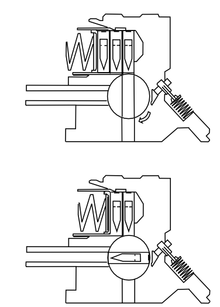
This diagram illustrates the G11'south unique feeding bike.
The weapon uses 4.73×33mm caseless ammunition, with the propellant shaped into cuboid blocks. The armament has besides been designated equally iv.92mm for the HK G11 ACR, a variant adult for US Armed services trials, the US convention of groove to groove measurements of the bore was employed, rather than land-country.[19] [ self-published source ] The projectile is four.93 mm in diameter with a instance length of 33 mm, the Us instance length measurement is 34 mm since for the ACR trials the bedroom length, non the actual case length was used. The 4.73 mm round is one-half the weight and twoscore% the size by volume of the five.56×45mm NATO round. The round was designed to the same ballistics requirement equally the five.56×45mm NATO round as outlined in Evaluation Procedures for Futurity NATO Weapons Systems (Document xiv). However, the 4.73mm is much less likely to tumble when hitting or penetrating a soft target, and thus non as lethal. The issue on soft targets is in accordance with international conventions. Fifty-fifty at short range, the round does not fragment in the soft target medium.[20] This was confirmed in tests with gelatine.[14](Run into terminal ballistics)
The design principle was to increase target hit probability by firing high rate multi-round bursts (salvos). Tests accept been run using a image shotgun test-bed chosen CAWS to see whether a unmarried-shot, multi-projectile system could achieve the range and hitting probability requirements. The results indicated that the use of serially fired projectiles at a high rate of burn would achieve a tight shotgun-similar pattern with rifle-similar accuracy up to the required range.
The rifle was designed to accept a dispersion such that a man-target running at a speed of 6 km/h at a distance of 250 m would exist striking even if the pb bending fault (2 mil) was off by 51 cm.[xx]
The weapon itself has three firing modes: semi-auto, total-machine at 460 rounds per minute, and 3-round flare-up at over 2100 cyclic rounds per minute, or approximately 36 rounds per second. The loading and feed machinery is physically very complicated just exceptionally fast and reliable. Rounds are fed into the weapon from a magazine that lies above and parallel with the barrel. The rounds are oriented vertically (at 90 degrees to the bore) and are fed downwards into the rotary chamber and so that they can be rotated 90 degrees for firing. The firing cycle process is roughly:
- As the cocking handle on the side is rotated clockwise past the weapon operator:
- A round is dropped into the revolving bedroom vertically (a loading piston assists).
- The chamber rotates ninety° then it is lined up with the barrel. This completes the chambering of the round and cocking of the firing pivot.
- When the trigger is pulled, a firing pin ignites the primer, which and then ignites a pulverization booster accuse that pushes the bullet into the barrel. The solid block of propellant is broken up to increase the ignition surface area and ignites, accelerating the bullet out of the barrel.
- As the projectile is accelerating up the barrel, recoil forces bulldoze the barrel, magazine, bedchamber and operating mechanism rearwards inside the weapon, dissipating energy for single shot and fully automatic modes but allowing flare-up mode to deliver three projectiles downrange before buffering occurs.
- Gas tapped off from the barrel rotates the chamber and actuates the loading mechanism, and then rotating the bedroom dorsum to the initial vertical position until information technology is lined up with the feed mechanism and the process repeats.
A conventional assault rifle has approximately viii steps in its bicycle:
- Bombardment: bolt grouping pushes round from mag into bedroom.
- Lockup: bolt or bolt carrier locks with the barrel extension or receiver.
- Firing: firing pivot or striker impacts primer igniting the main propellant charge.
- Unlocking: either through gas, recoil or blow-dorsum operation, the working parts unlock from the barrel extension or receiver.
- Extraction: spent case is extracted and withdrawn from the chamber.
- Ejection: the spent case is thrown clear of the weapon either via a commodities face ejector or from a fixed or semi-fixed ejector.
- Firing mechanism reset: as part of the rearward reciprocation of the working parts, the firing machinery is reset.
- Buffering: working parts finally strike the buffer and halt. Recoil bound(s) are fully compressed and begin to bulldoze the working parts forrard into battery.
Because the G11 uses caseless ammunition, there are no extraction and ejection steps. Fifty-fifty though the rotary bedroom does not lock up in the true sense of the word, the fact that it has to rotate in and out of alignment with the barrel ways that the G11 tin can be considered to take a lock/unlock phase. If a round fails to fire or the weapon is existence used with training rounds, the rifle can exist manually unloaded by twisting the cocking handle counterclockwise. This pushes the failed/preparation round out an emergency ejection port on the bottom of the burglarize and loads the adjacent circular.
The recoil in the iii-round burst is non felt by the weapon's user until after the third circular has left the bedchamber. This is achieved by having the barrel and feeding mechanism "bladder" within the rifle casing. When the rounds are fired, the barrel, mag, bedroom and operating mechanism recoils back against recoil springs several inches. But when information technology strikes the buffer at the dorsum of the rifle does the user feel the recoil. During the rearward travel of the internal machinery the rifle loads and fires 3 rounds. When the butt and mechanism reaches the rearmost point in its travel, the recoil springs push it forwards, dorsum into its normal forward position. When firing in semi-auto and full-motorcar modes, the rifle loads and fires merely one round per move of the internal mechanism. Fully automatic burn is reduced to around 460 rounds per minute. The internal workings of the rifle were rather complex compared to those of some earlier designs, with the mechanism being compared to the inside of a compact clock. The number of hours of maintenance required for the G11 compared to other designs is not clear, especially since the effect of the powder used in the caseless ammo remains unknown. Designers claimed that, considering there was no ejection cycle, the internal mechanisms would take little take chances to get exposed to external dust, dirt and sand, which would supposedly reduce the need for cleaning.
There were reports that the loftier tolerances required to seal off the front and rear chamber openings set up the expected life of the contacting parts to 6000 rounds before maintenance was required.
| 4.73×33mm | ||||||||
|---|---|---|---|---|---|---|---|---|
 The four.73×33mm caseless armament used in the G11 burglarize. The components are, from left to right, the solid propellant, primer, the bullet, and a plastic cap that serves to keep the bullet centered in the propellant block. | ||||||||
| Type | Rifle | |||||||
| Place of origin | Germany | |||||||
| Production history | ||||||||
| Designer | Heckler & Koch | |||||||
| Specifications | ||||||||
| Example blazon | Caseless | |||||||
| Bullet bore | 4.70 mm (0.185 in) | |||||||
| Base diameter | 7.76 mm (0.306 in) | |||||||
| Overall length | 32.83 mm (1.293 in) | |||||||
| Rifling twist | 155 mm (1 in 6.ane in) | |||||||
| Maximum force per unit area | 385.00 MPa (55,840 psi) | |||||||
| Ballistic operation | ||||||||
| ||||||||
| Examination barrel length: 540 mm (21 in) | ||||||||
Ammunition cook-off and shape [edit]
Premature ignition of armament from heat in the chamber, known as cook-off, was a major trouble with early prototypes of the G11 where synthetically bound nitrocellulose, formed into blocks, was used. Usually, when a cartridge is fed into a sleeping room, its case insulates the propellant from igniting until its impact-sensitive primer is struck by a firing pivot or striker. The case aids in insulating the propellant from the heat of the bedchamber and it takes time for the temperature to rise sufficiently within a chambered round to ignite the propellant. In addition, in a traditional rifle, extracting a hot case removes heat from the system. Equally a result of doing away with traditional cases, the G11 was plant to be unsafe and had to be withdrawn from the 1979 NATO trials. The loftier rate of burn down and lack of cartridge cases fabricated cooking off a significant problem; the oestrus buildup in the G11 chamber was immense because the chamber had no provision for cooling like a reciprocating bolt system, which allows hot air to leave the bedchamber when the commodities is retracted and the chamber is exposed to air. The vertically swiveling chamber also made gas sealing at each stop at such loftier pressures impractical, as opposed to a cantankerous-sectional round-inside-round bolt-to-chamber fit with proper gas sealing.
To solve this, Heckler and Koch formed a partnership with Dynamit Nobel, which redesigned the cartridge to use a new high ignition temperature propellant (HITP). The cook-off problem was reduced by using a denatured HMX propellant with a special folder and coating for the ammunition that increased the spontaneous ignition temperature past another 100 °C to a higher place that of standard, nitrocellulose (180 °C) propellant.[eleven]
A notable characteristic of the new round was its unconventional shape. Nigh cartridge casings are cylindrical, simply the redesigned cartridge was molded into a squared, box-like shape. This allowed the 50-cartridge mag to conduct more than propellant in a smaller space; the wasted space between rounds with cylindrical casings was essentially reduced.
The consequence of estrus removal from caseless-firing weapons as well as methods of igniting them continue to exist researched by other companies. An alternative route was taken past the Austrian visitor Voere, whose Voere VEC-91 uses a caseless, electrically-fired round developed past Austrian inventor Hubert Usel. This technique makes it possible to profoundly increment the ignition temperature without hampering the ability to fire it. This would increase the maximum charge per unit and duration a gun could burn down before cooking off rounds, simply the VEC-91 never took advantage of this, since it was a bolt-action rifle.
The iv.73×33mm projectile was required to defeat NATO and Warsaw Pact armor at 300–400 m (Certificate 14) just was advertised to run into the requirement at 600 thou.[twenty] This fact was neither confirmed nor denied past the Due west German government, citing inability to disclose such information.[14]
In line with another NATO requirement for a personal defense weapon (PDW), a handgun concept, Nahbereichswaffe (NBW),was created. It was to use a shortened 4.73×25 mm cartridge and meet the aforementioned requirements at present fulfilled past the HK 4.six×30mm: Armor piercing of NATO CRISAT Technology Area 1 (TA1) out to 300 m; Level Two out to 25 k; lethal suppression fire against unarmored targets out to 450 m.[7] [21]
| Cartridge | Cartridge weight | Projectile weight | Weight of loaded magazine | example ammo. load | Pressure | Velocity | Energy | Recoil Energy Factor (Impulse²) |
|---|---|---|---|---|---|---|---|---|
| 4.73×33 mm | v.ii yard | iii.25 thou | 45 rd mag @0.25 kg 15 rd reload @0.11 kg | ii mags + 28 reloading units 3.58 kg total for 510 rds | 3850 bar | 930 m/s | 1470 J/ft lb[22] | 28[22] |
| 4.73×25 mm | 4 k | 2.75 thou | 20–40 rd magazine | 2750 bar | 585 grand/s | 280+ J @range |
Hereafter development [edit]
By 2004, the technology adult for the G11 was licensed for the Lightweight Small Arms Technologies project,[xv] the current projection of which is a light car gun paradigm for the Us Army. The pattern is intended to use either a cased cartridge using a composite instance or a caseless armament pattern developed from the G11. Both ammunition designs are telescoped ammunition like that used past the G11; however, the current ammunition design has a plastic case instead of the fully caseless G11 ammunition. The design, similar the G11, uses a rotating chamber, but rotating about the longitudinal axis of the weapon.
See also [edit]
- AAI ACR
- AN-94
- Armtech C30R
- Benelli CB M2
- Gerasimenko VAG-73
- List of assault rifles
- List of bullpup firearms
- List of automobile guns
- Metal Storm
- Steyr ACR
- Voere VEC-91
References [edit]
- ^ "TAB Special Episode: G11 Disassembly & How It Works". YouTube. Archived from the original on 28 November 2018. Retrieved 3 December 2018.
- ^ a b SoldierTech: The Gun That Never Was
- ^ "Visitor History". Heckler & Koch. Archived from the original on 2008-08-27. Retrieved 2010-01-05 .
- ^ Woźniak, Ryszard. Encyklopedia najnowszej broni palnej - tom two Grand-Ł. Bellona. 2001. pp. 17–21.
- ^ a b c d e f Le Fusil d'Assaut Allemand M-11 a Munitions sans Étui Archived 2014-05-08 at the Wayback Automobile Yves-Louis Cadiou, Gazette des Armes n°106, pp. 12–15, June 1982
- ^ Jane's Infantry Weapons, Jane's Data Group, 2002
- ^ a b c d e f m h i Dice G11 Story. Die Entwicklungsgeschichte einer High-Tech-Waffe, Wolfgang Seel, Periodical Verlag Schwend GmbH, 1993, ASIN: B0027WQJAE
- ^ a b c d e f Gedämpftes Pressen Archived 2014-05-12 at the Wayback Car Der Spiegel 19/1982, 1982 Nr. 19, pp. 223–227, May x, 1982
- ^ Automated or semi-automated small arm Archived 2018-xi-06 at the Wayback Machine patent US4078327, March fourteen, 1978
- ^ Smith, Due west.H.B.; Ezell, E. C. (1983), Small Arms of the World, 12th Edition, Stackpole Company, Harrisburg PA
- ^ a b Caseless armament, especially for attack rifles, automobile guns and sniper rifles of the same calibre Archived 2014-06-xiv at the Wayback Automobile Siegfried Trost, Patent publication DE3834925 A1, Apr 19, 1990
- ^ Pulver im Turm Archived 2014-05-12 at the Wayback Automobile Der Spiegel 31/1987, 1987 Nr. 31, pp. 151–152, July 27, 1987
- ^ a b c d Versteck dich, wenn sie schießen: Die wahre Geschichte von Samiira, Hayrettin und einem deutschen Gewehr Archived 2016-03-04 at the Wayback Machine Jürgen Grässlin, Droemersche Verlagsanstalt, p. 399, 2003, ISBN 3-426-27266-0
- ^ a b c d Antwort der Bundesregierung auf dice Kleine Anfrage der Abgeordneten Frau Vennegerts und der Fraktion DIE GRÜNEN: Entwicklung und Einsatz neuartiger Gewehrsysteme und hülsenloser Munition(G eleven) Archived 2014-05-12 at the Wayback Auto Deutscher Bundestag, Drucksache eleven/7055, May 3, 1990
- ^ a b "Caseless Ammunition (Lightweight Small Arms Technology – LSAT) Euro Insensitive Munitions & Energetic Materials Symposium" (PDF). 24–28 March 2006. p. 7. Archived from the original (PDF) on 31 March 2010. Retrieved 2010-04-11 .
- ^ a b Weg is weg Archived 2014-05-12 at the Wayback Machine Der Spiegel 3/1992, 1992 Nr. 3, pp. 68–70, Jan fourteen, 1992
- ^ LIGHTWEIGHT SMALL ARMS TECHNOLOGIES Archived 2014-05-25 at the Wayback Machine AAI Corporation, May xi, 2006
- ^ Lightweight Small Artillery Technologies Archived 2017-01-ten at the Wayback Machine Kori Spiegel, United states of america Army ARDEC, May, 2008
- ^ HK G11 Archived 2009-07-27 at the Wayback Automobile
- ^ a b c Weapon Armament System: G11 rifle with caseless ammunition [ permanent dead link ] G11 brochure, Heckler & Koch Dynamit Nobel, 1990
- ^ [https://web.archive.org/spider web/20150128132434/http://world wide web.dwj.de/magazin/topthema/details/items/385.html Archived 2015-01-28 at the Wayback Machine "Heckler & Koch MP7 und das Kaliber 4,half dozen mm ten 30 "] Deutsches Waffen Journal, August i, 2010
- ^ a b Popenker, Saying, and Anthony G. Williams. Assault rifle. Ramsbury (Marlborough): Crowood Press, 2005. Print.
Farther reading [edit]
- Weapon Ammunition System: G11 rifle with caseless ammunition, Heckler & Koch Dynamit Nobel, 1981
- Operator'due south Manual: Rifle, 4.92 mm ACR, Heckler & Koch, March 1989
- Weapon Ammunition Organisation: G11 rifle with caseless ammunition, Heckler & Koch Dynamit Nobel, 1990
- Wolfgang Seel, Die G11 Story. Dice Entwicklungsgeschichte einer High-Tech-Waffe, Journal Verlag Schwend GmbH, 1993, ASIN: B0027WQJAE
- Jürgen Grässlin, Versteck dich, wenn sie schießen: Dice wahre Geschichte von Samiira, Hayrettin und einem deutschen Gewehr, Droemersche Verlagsanstalt, 2003, ISBN 3-426-27266-0
- Terry Gander, Jane'southward Infantry Weapons 1996–1997, 1996, ISBN 978-0710613547
External links [edit]
- HKPRO
- Supervisiere für eine Superwaffe: Die Visierentwicklung für das Gewehr Thou 11
- SoldierTech
- Mod Firearms
- U.S. Ground forces Lightweight Small Artillery Technologies
- Video of operation on YouTube
- Industrie Werke Karlsruhe G11
- IWK G11
- Video of field strip, operation, maintenance, detailed parts explanation on YouTube
matsonwhempos1944.blogspot.com
Source: https://en.wikipedia.org/wiki/Heckler_%26_Koch_G11
0 Response to "Will Heckler and Koch Make 94s Again?"
Post a Comment