Bill to Exempt Family Owned Homes Under Topa
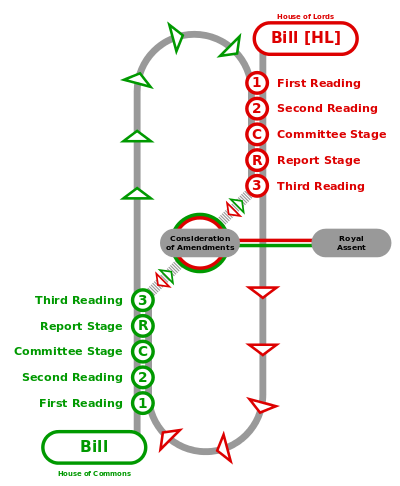
A bill is proposed legislation nether consideration by a legislature.[1] A beak does not get constabulary until it is passed past the legislature as well every bit, in nearly cases, approved by the executive. Once a beak has been enacted into police force, it is called an human action of the legislature, or a statute. Bills are introduced in the legislature and are discussed, debated and voted upon.
Usage [edit]
The= discussion nib is primarily used in Anglophone United Kingdom, the parts of a pecker are known as clauses, until it has become an act of parliament, from which fourth dimension the parts of the constabulary are known as sections.[two]
In Napoleonic police nations (including France, Belgium, Grand duchy of luxembourg, Spain and Portugal), a proposed law may be known as a "police project" (Fr. projet de loi), which is a authorities-introduced pecker, or a "law proposition" (Fr. proposition de loi), a private member's beak. For instance the Dutch parliamentary system does not make this terminological distinction (wetsontwerp and wetsvoorstel being used interchangeably).
Grooming [edit]
Bills generally include titles, enacting provisions, statements of intent, definitions, substantive provisions, transitional clauses, and dates which the pecker will be put into effect.[3] The grooming of a bill may involve the production of a draft bill prior to the introduction of the bill into the legislature.[4] In the United Kingdom, draft bills are frequently considered to be confidential.[5] Pre-legislative scrutiny is a formal process carried out by a parliamentary committee on a draft bill.[6]
In Parliament of India, the draft bill is sent to individual ministry relating to the thing. From there the bill goes to Ministry of Constabulary and Justice (India) and then is passed on to Cabinet committee which is headed by Prime number Government minister.
Pre-legislative scrutiny is required in much of Scandinavia, occurs in Ireland at the discretion of the Oireachtas (parliament) and occurs in the UK at the regime's discretion.[7]
In the Parliament of Ireland under Poynings' Law (1494–1782) legislation had to be pre-approved by the Privy Council of Republic of ireland and Privy Council of England, then in practice each nib was substantively debated as "heads of a bill", then submitted to the privy councils for approval, and finally formally introduced equally a bill and rejected or passed unamended.[viii]
Introduction [edit]
In the Westminster system, where the executive is drawn from the legislature and commonly holds a majority in the lower house, most bills are introduced past the executive (government bill). In principle, the legislature meets to consider the demands of the executive, as set out in the Queen'due south Voice communication or Speech from the Throne.
While mechanisms exist to let other members of the legislature to introduce bills, these are subject to strict timetables and usually neglect unless a consensus is reached. In the US system, where the executive is formally separated from the legislature, all bills must originate from the legislature. Bills can be introduced using the following procedures:
- Exit: A move is brought before the chamber asking that leave be given to bring in a bill. This is used in the British system in the form of the Ten Infinitesimal Rule motion. The legislator has ten minutes to propose a pecker, which can then exist considered by the House on a day appointed for the purpose. While this dominion remains in place in the rules of process of the US Congress, it is seldom used.
- Government motion: In jurisdictions where the executive tin command legislative business a bill may exist brought in by executive fiat.
Legislative stages [edit]
Bills are more often than not considered through a number of readings. This refers to the celebrated practice of the clerical officers of the legislature reading the contents of a bill to the legislature. While the bill is no longer read, the motions on the pecker still refer to this do.
In the British/Westminster system, for a new constabulary to exist made it starts off as a beak and has to get through the 7 stages of the legislative process. These are: Get-go Reading, Second reading, Committee stage, Written report Stage, 3rd Reading, Contrary House, and and so Royal Assent. A bill is introduced usually by a Member of Parliament (MP) in the Business firm of Commons or by a member of the Firm Of Lords.
There volition exist a first reading of the bill, in which the proffer in the bill is read out, but there is minimal discussion and no voting.
Afterward this there is a 2nd reading of the bill, in which the bill is presented in more detail and it is discussed between the MPs or Lords.
The third phase is the commission phase, in which a committee is gathered. This may include MPs, Lords, professionals and experts in the field, and other people who the bill may bear on. The purpose of this stage is to go into more detail on the bill and assemble expert opinions on it (eastward.g. teachers may be nowadays in a committee well-nigh a bill that would bear on the teaching system) and amendments may be brought.
After this is the report stage, in which the entire business firm reviews any and all changes made to the bill since its conception and may bring further amendments.
The fifth phase is the 3rd reading of the beak, in which the full bill is read out in the house along with all amendments and is given final blessing past the House.
The next stage is where the nib is handed over to the opposite house for approval. (If information technology started in the House of Commons it volition exist handed to the House of Lords and vice versa.) Here the bill will go through the verbal same process as before, with amendments able to be brought. If amendments are brought the bill volition once again be handed to the contrary house, going through the same process, which repeats until both houses arrive at an agreement on the neb. (In the rare circumstance that the ii houses cannot concord, the Business firm of Commons has the terminal say equally it is an elected torso, whereas the House Of Lords is not).
Once the bill is finalized, it will move to the concluding stage, Royal Assent. In this the slice of legislation is given to the Monarch (currently Queen Elizabeth Two) to give her purple assent for the bill to go constabulary. Though the monarch does have the right to refuse to exercise so, the monarch is but able to encounter the short championship of bill, for example, they would just be able to see "Offensive Weapons Act 2019". Once the assent is granted the police force comes into result at the date and time specified inside the act, if this is non specified within the act, it volition come into result at midnight on the same mean solar day it was granted royal assent.
India [edit]
In Bharat, for a law to be made it starts off as a beak and has to go through various stages:
- At that place will be "first reading" of the beak where minister takes exit from the house and introduces title and objectives of the bill. Here, no discussion or voting takes place. And then the neb is published in Gazette of India.
- Afterward this at that place is a "second reading" of the bill, where the bill receives its final shape.
- The bills commencement go through the 'stage of general discussion' where the bill is referred to select committee/ joint committee for detailed scrutiny through a motion.
- Under 'committee stage' the bill is scrutinized in detail in the commission and a report is submitted in the respective business firm.
- Under 'consideration phase' the bill is discussed in detail in the house and is voted upon.
- Then under "third reading" the bill is voted upon every bit a whole and if majority of the firm present and voting favours the nib, and then the bill is considered passed and is authenticated by presiding officer.
- The bill is then passed to the other house for its consideration.
- And if both houses concur, the bill reaches the President where he can assent, withhold assent, render for consideration and can also sit down on the beak.
Enactment and after [edit]
Where a slice of principal legislation is termed an act, the procedure of a bill condign law may be termed enactment. In one case a nib is passed by the legislature, it may automatically become law, or it may need further approval, in which example enactment may be effected by the approver's signature or declaration.
Approval [edit]

A bill to improve the act entitled "An act to organize forces to serve during the state of war," canonical Feb. 17, 1864.
Bills passed by the legislature unremarkably require the approval of the executive such as the monarch, president, or governor to get law.[nine] Exceptions are the Irish gaelic Complimentary Country from the abolition of the Governor-General in Dec 1936 to the cosmos of the function of President in December 1937, and Israel from its formation until today, during which period bills approved by the Oireachtas and Knesset respectively became/become law immediately (though, in State of israel's case, the laws are ceremonially signed after their passage by the President).
In parliamentary systems, approval of the executive is normally a formality since the head of state is directed by an executive controlled past the legislature. In constitutional monarchies, this blessing is called royal assent. In rare cases, blessing may exist refused or "reserved" by the head of country's utilise of a reserve ability. The legislature may have significantly less power to introduce bills on such issues and may require the approval beforehand. In Republic realms the regal prerogative informs this. In the Britain, for instance, cases include payments to the purple family, succession to the throne, and the monarch's practice of prerogative powers.
In presidential systems, the need to receive blessing can exist used every bit a political tool past the executive, and its refusal is known as a veto. The legislature may be able to override the veto by means of a supermajority vote.
In some jurisdictions, a beak passed by the legislature may also require approving past a constitutional court. If the court finds the bill would violate the constitution it may counteract it or send it back to the legislature for correction. In Ireland, the President has discretion under Article 26 of the Constitution to refer bills to the Supreme Courtroom. In Deutschland, the Federal Constitutional Court has discretion to rule on bills.
Some bills may require approving by referendum. In Republic of ireland this is obligatory for bills to amend the constitution; it is possible for other bills via a process that has never been used.
Afterwards [edit]
A bill may come into force as presently as it becomes constabulary, or it may specify a later engagement to come up into force, or information technology may specify by whom and how it may be brought into force; for example, by ministerial gild. Dissimilar parts of an act may come into force at different times.
An human action is typically promulgated by beingness published in an official gazette. This may be required on enactment, coming into forcefulness, or both.
Numbering of bills [edit]
Legislatures give bills numbers equally they progress.
United states [edit]
In the U.s.a., all bills originating in the House of Representatives begin with "H.R." and all bills originating from the Senate begin with an "S.". Every two years, at the first of odd-numbered years, the Us Congress recommences numbering from 1, though for bills the Business firm has an society reserving the get-go 20 bill numbers and the Senate has similar measures for the first x bills. Articulation resolutions as well accept the same effect as bills, and are titled as "H. J. Res." or "S. J. Res." depending on whether they originated in the Business firm or Senate, respectively. This means that two different bills can have the same number. Each two-twelvemonth bridge is called a congress, tracking the terms of Representatives elected in the nationwide biennial House of Representatives elections, and each congress is divided into year-long periods called sessions.[10]
United Kingdom [edit]
In the United Kingdom, for example, the Coroners and Justice Act in 2009 started every bit Bill 9 in the Firm of Eatables. So it became Beak 72 on consideration by the Committee, afterwards that information technology became Firm of Lords Nib 33. Then it became House of Lords Bill 77, returned to the House of Eatables every bit Bill 160 before finally existence passed as Human action 29.[xi] [12] Parliament recommences numbering from one at the beginning of each session. This means that two different bills may have the aforementioned number. Sessions of parliament usually last a yr. They begin with the State Opening of Parliament, and finish with Prorogation.
Republic of ireland [edit]
In the Irish Oireachtas, bills are numbered sequentially from the kickoff of each agenda year. Bills originating in the Dáil and Seanad share a common sequence. In that location are separate sequences for public and individual bills, the latter prefixed with "P". Although acts to amend the constitution are outside the almanac sequence used for other public acts, bills to improve the constitution are within the annual sequence of public bills.[thirteen]
Philippines [edit]
In the Philippines, all bills passed into law, regardless of whether they were introduced in the House of Representatives or the Senate, are numbered sequentially beginning with the first Republic Act that became police on July 15, 1946. In that location have been 11,646 Republic Acts as of January 21, 2022.[fourteen] [xv]All Laws passed by Congress, once given Presidential Assent become law and are given a sequential number and are prefixed with "Commonwealth Act" or "R.A." for short. They are too given a secondary sequential number by the chamber they are introduced in. Same numberings restart every 3 years after the formation of a new Congress.
Meet also [edit]
- Legislation
- List of legislatures by land (most legislature articles have information on their processes)
- Resolution (police)
- White paper
- Bill (United states of america Congress)
- Procedures of the United States Congress
- Private bill
References [edit]
- ^ [1] - Teaching 2020: Government course; topic House of Representatives (USA), definition of bill: "A proposed constabulary presented to a legislative trunk for consideration."
- ^ "Clauses - Glossary folio". United kingdom of great britain and northern ireland Parliament . Retrieved 15 July 2015.
- ^ Kealy, Sean. "African Parliamentary Noesis Network Legislative Handbook: Using Evidence to Design and Appraise Legislation" (PDF).
- ^ Hilaire Barnett. Constitutional and Administrative Law. Second Edition. Cavendish. 1998. Folio 537.
- ^ Bradley and Ewing. Constitutional and Administrative Law. Twelfth Edition. Longman. 1997. Folio 718.
- ^ "Glossary page — Pre-legislative scrutiny". United kingdom Parliament . Retrieved four February 2019.
- ^ "Pre-legislative scrutiny (PLS) by parliament" (PDF). Spotlight. Oireachtas.
- ^ Kelly, James (2006). "The making of constabulary in eighteenth-century Ireland : the significance and import of Poynings' constabulary". In Dawson, Norma (ed.). Reflections on Law and History: Irish Legal History Society Discourses and Other Papers, 2000–2005. Irish Legal History Society. Vol. 17. Four Courts Printing. pp. 259–277. ISBN9781851829378.
- ^ "Archived copy". Archived from the original on 12 March 2009. Retrieved 17 May 2009.
{{cite web}}: CS1 maint: archived copy as title (link) - ^ "GovTrack: Search Legislation in Congress". GovTrack.united states of america. Retrieved 30 March 2009.
- ^ "Coroners and Justice Neb 2008–09". Archived from the original on thirteen February 2010.
- ^ "Coroners and Justice Deed 2009" (PDF). Office of Public Sector Information. 12 November 2009. Archived (PDF) from the original on 31 March 2010. Retrieved 23 March 2010.
- ^ For example, the list of Oireachtas bills for 2002 includes numbers 31 and 32 (ramble amendments) 45 and 47 (originating in Seanad) 46 (originating in Dáil) and P1 (private).
- ^ "Democracy Acts | Official Gazette of the Republic of the Philippines". Official Gazette of the Democracy of the Philippines . Retrieved 26 January 2022.
{{cite spider web}}: CS1 maint: url-condition (link) - ^ "Republic Act No. 11646 | GOVPH". Official Gazette of the Republic of the Philippines . Retrieved 26 Jan 2022.
{{cite web}}: CS1 maint: url-condition (link)
External links [edit]
Hong Kong [edit]
- Bills Committees of the Legislative Council
Republic of india [edit]
- The Indian Constitution
- Government of India Laws
Ireland [edit]
- How laws are made
- Find bills and acts (since 1922; partial)
- Bills (since 1997; complete)
New Zealand [edit]
- Parliamentary Counsel Office—Terminology: What are Acts, Bills, regulations, and Supplementary Guild Papers (SOPs)?
- List of electric current bills
United Kingdom [edit]
- Great britain Parliament Guide: Passage of a Neb
- BBC Parliament Guide:
- Making new law
- Types of bill
- Pecker procedure
- First reading
- Second reading
- Commons committee phase
- Lords committee stage
- Report stage
- Third reading
- Passage through the other House
- Royal assent
- Delegated legislation
United States [edit]
- Bills, Resolutions Archived 19 Baronial 2010 at the Wayback Auto at THOMAS
- Regime 101: How a neb becomes a constabulary at Project Vote Smart
- Federal legislation at GovTrack
- How a law is made at the North Carolina General Associates
matsonwhempos1944.blogspot.com
Source: https://en.wikipedia.org/wiki/Bill_(law)
0 Response to "Bill to Exempt Family Owned Homes Under Topa"
Post a Comment